


 English
  عربى
عربى  中文简体
中文简体
What Makes Fire Blanket Car Fire Isolation Hard During Battery Thermal Runaway
Electric vehicles are now part of everyday traffic in places where people live, work, and park for long hours. This shift changes how fire incidents are understood inside enclosed environments like parking garages, service areas, and charging zones.
A fire involving a battery does not behave in a simple way. The heat does not always stay visible. Flames may appear and then reduce for a period, while internal reactions continue inside the battery structure. This creates a situation where the outer appearance of the vehicle does not always match what is happening inside.
Fire blanket car fire isolation is used in these environments to reduce the spread of heat and smoke toward surrounding areas. The idea is to limit how fire interacts with nearby vehicles and structures. Even so, when thermal runaway begins inside a battery system, control becomes more complex than expected.
The main difficulty comes from the fact that energy release continues inside the battery even when the outside surface looks calmer. This internal activity affects heat movement, flame behavior, and smoke patterns under the cover.
What Happens Inside a Battery During Thermal Runaway
Inside a vehicle battery, energy is stored in tightly packed cells. Under normal use, these cells remain stable. When internal imbalance appears, heat starts building inside a small section.
This change may not be noticeable outside the vehicle. Over time, heat spreads from one cell to another. This creates a chain reaction inside the battery pack.
In real environments such as parking garages or charging stations, early signs may include:
- Light smoke near the lower part of the vehicle
- Unusual heat from the floor area
- Small popping sounds from beneath the body
- Gradual increase in surface temperature
As internal heat continues to spread, the reaction becomes harder to control. The important point is that visible flames often appear later than the internal heating process.
This delay creates a gap between what people see and what is actually happening inside the battery.
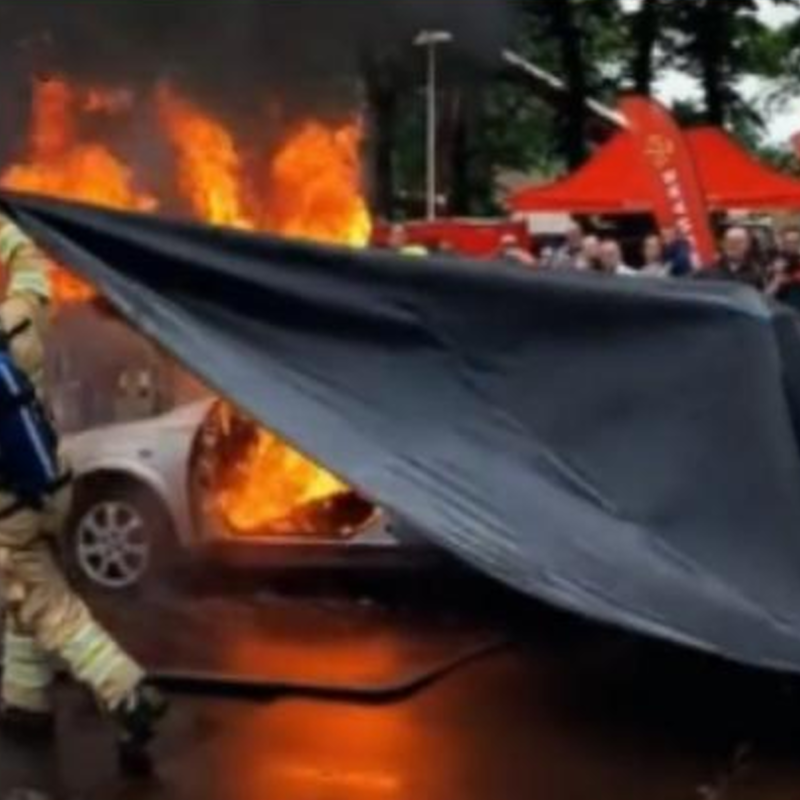
Even when flames reduce, internal heat can remain active. This is one reason why isolation methods continue to be used during monitoring stages.
Why Does Fire Blanket Car Fire Isolation Become Difficult During Continuous Internal Heat Release
Once a vehicle is covered for isolation, external flames may appear reduced. The environment outside the vehicle often looks more stable at first glance. Inside the battery system, heat may still be active.
This creates a condition where containment and internal activity do not align.
In enclosed environments, several effects appear:
- Heat remains trapped under the vehicle floor
- Temperature spreads through structural parts of the car body
- Lower sections stay hot longer than upper surfaces
- Surrounding air may still carry warm flow from beneath the cover
A key difficulty is that the heat source does not stop at the same time as the visible flame. The fixed cover limits external spread, yet internal reaction continues independently.
This leads to a situation where the surface appears controlled while internal movement continues underneath.
Why Does Fire Blanket Car Fire Isolation Struggle With Unstable Flame Movement
During thermal runaway, flames do not always remain in one location. Instead, they may appear at different points under the vehicle body.
This behavior is related to how heat moves inside the battery and surrounding materials.
Common patterns observed in real situations include:
- Flames appearing near wheel sections
- Heat escaping from lower side panels
- Sudden flame activity under the center of the vehicle
- Shifting heat zones beneath the cover
In enclosed parking structures, this movement becomes more noticeable because airflow is limited. Heat does not disperse easily into open space. Instead, it moves within confined areas under and around the vehicle.
This creates a challenge for maintaining stable coverage. A fixed layer can limit outward spread, yet it does not stop internal movement of heat and flame points.
| Situation Under Vehicle | Effect on Surrounding Environment |
|---|---|
| Heat shifting between sections | Uneven temperature around floor area |
| Flame near wheel zone | Localized risk to nearby surfaces |
| Smoke release points changing | Reduced clarity for monitoring |
| Heat rising under cover edges | Warm air movement in parking lane |
In daily parking environments, this behavior requires continuous attention even after the vehicle is covered.
Why Does Gas Release Inside the Battery Affect Fire Blanket Car Fire Stability
Inside a battery under thermal stress, gas may build up as internal materials react to heat. This gas does not remain stable. It may release suddenly depending on pressure conditions inside the battery pack.
When this happens, several effects can be observed:
- Sudden movement of smoke under the cover
- Temporary increase in heat around the vehicle base
- Shifts in airflow direction inside enclosed areas
- Disturbance of stable containment conditions
Gas release changes the balance of heat and airflow. Even a covered vehicle can experience internal pressure movement that affects surrounding air behavior.
In parking garages or service areas, this can influence nearby conditions. Smoke may move toward different lanes. Heat pockets may appear close to floor level. Visibility may also change in short periods.
Because gas behavior is unpredictable, isolation becomes more complex during this stage. The cover remains in place, yet internal movement continues underneath.
Why Is Visibility Reduced During Fire Blanket Car Fire Isolation
Once a vehicle is fully covered, direct visual access becomes limited. This creates a challenge for responders and facility staff who need to monitor the situation.
Smoke often accumulates under the covering layer. Instead of dispersing into open air, it stays close to the vehicle body. This makes it difficult to observe internal changes directly.
In practical environments, several conditions are common:
- Smoke escaping from small gaps around the edges
- Heat movement that cannot be seen directly
- Sound changes inside the vehicle structure
- Limited view of flame activity beneath the cover
Because of this, monitoring often depends on indirect signs rather than visual confirmation.
These may include:
- Heat felt near surrounding surfaces
- Air movement changes in nearby lanes
- Smoke intensity around edges
- Changes in noise levels from the vehicle
In enclosed spaces like underground parking structures, reduced visibility also affects surrounding operations. Nearby vehicles may need to be moved slowly, and access routes may remain restricted during observation.
How Do Environmental Conditions Influence Fire Blanket Car Fire Isolation in Real Spaces
The space around a vehicle fire changes how the situation develops, sometimes more than people expect. A parking garage, a charging corner, or a storage lane does not behave like open air. Heat stays longer, smoke moves differently, and visibility drops in uneven ways.
In real parking areas, the surroundings often work against clear control of heat movement. Concrete surfaces hold warmth and reflect it back. Tight lanes limit airflow. Vehicles parked side by side create narrow gaps where heat can travel quietly.
Even when a vehicle is covered for isolation, the environment keeps influencing what happens outside the cover.
Common effects include:
- Warm air staying close to floor level
- Smoke drifting along ceilings instead of rising away
- Heat passing slowly between parked vehicles
- Air pockets forming in narrow corners
These conditions do not stop isolation from working, but they make the situation harder to read and manage. The covered vehicle becomes part of a larger heat environment instead of an isolated point.
How Does Timing Affect Fire Blanket Car Fire Deployment During Thermal Runaway
Timing often decides how difficult the situation becomes later.
In many real cases, the early stage does not look serious. A bit of smoke under the car, a strange smell near a charging spot, or light heat near the wheels. At that moment, the situation still feels uncertain rather than fully developed.
As heat builds inside the battery, things shift quickly. Smoke thickens, and small flame points may appear under the vehicle body. Once that happens, surrounding vehicles and structures can already start feeling the heat.
When isolation is applied early, the situation usually stays more contained around the vehicle. When it is delayed, smoke and heat have more time to spread through nearby lanes.
During deployment, everything moves fast:
- People clear the area
- Nearby vehicles may still be moving
- Smoke conditions can change direction
- Heat levels are still rising
This overlap creates pressure. Actions happen while the situation is still changing, not after it becomes stable.
What Happens to Heat Under Fire Blanket Car Fire Coverage
Once the cover is placed over the vehicle, the scene looks calmer from a distance. Flames become less visible, and smoke movement changes direction. That visual change can be misleading.
Inside the covered space, heat does not disappear. It shifts and stays active in different parts of the vehicle body.
What usually happens under the cover:
- Heat gathers near the lower sections of the vehicle
- Some areas stay hotter than others
- Warm air moves slowly toward small openings
- Internal battery reactions may continue for a while
The key point is that the cover changes airflow, not internal activity. Heat that was moving freely before now becomes trapped in a tighter space.
In enclosed parking structures, this trapped heat may still affect nearby surfaces. The floor, adjacent vehicles, and even nearby walls can continue absorbing warmth for some time.
Why Is Monitoring Fire Blanket Car Fire Isolation Difficult After Deployment
Once the vehicle is covered, direct sight disappears. That is where the difficulty begins.
Without visual access, responders and staff rely on indirect signs. This is not always simple, especially in a busy or enclosed parking environment.
What can still be observed:
- Smoke leaking from edges of the cover
- Changes in sound coming from inside the vehicle
- Warm air around the ground area
- Shifts in smoke density nearby
These signals are not always clear. Sometimes smoke reduces for a while, then returns. Sometimes sound changes without a visible reason. The situation does not stay steady.
Inside parking garages, this stage can feel slow. Movement around the area often stays restricted. Nearby vehicles may remain parked in place until conditions feel stable enough for traffic again.
How Do Parking Garages and Charging Areas Influence Fire Blanket Car Fire Challenges
Modern parking areas are not open and empty spaces. They are structured environments filled with vehicles, cables, signs, pillars, and narrow driving lanes.
These details matter during a fire situation.
In charging areas, vehicles may be placed close together. Charging equipment adds fixed points where vehicles cannot be moved easily. This creates tight layouts where heat has fewer escape paths.
In underground garages, airflow is often limited. Smoke does not move away quickly. Instead, it travels across ceilings or collects in certain zones. That makes visibility harder for both drivers and responders.
Some practical issues seen in real spaces include:
- Limited room to deploy large equipment
- Tight corners that slow movement
- Heat staying longer between parked cars
- Smoke collecting in central lanes
- Restricted access near charging spots
Because of this, isolation methods are not only about the burning vehicle. They also involve managing the surrounding space.
Why Does Fire Blanket Car Fire Isolation Require Coordinated Response in Real Incidents
A single person cannot manage every part of a vehicle fire inside a parking structure. Several actions happen at the same time, and they all affect each other.
One group may focus on clearing nearby vehicles. Another may handle the covering process. Others may watch surrounding smoke movement or control access into the area.
Typical coordination tasks include:
- Moving vehicles away from heat zones
- Keeping access paths open
- Managing crowd movement or traffic inside the structure
- Monitoring smoke spread in nearby lanes
- Communicating changes in conditions
Even small delays or unclear communication can slow down the process. In enclosed spaces, timing and coordination often matter more than individual steps.
What Material Factors Influence Fire Blanket Car Fire Performance Under Thermal Stress
The cover used for isolation is exposed to strong and uneven conditions during a battery fire. Heat is not evenly distributed. Some areas of the vehicle release more heat than others, especially near the lower body.
A few practical material behaviors are often considered:
- The surface needs to stay stable under long heat exposure
- The structure must hold shape during movement and adjustment
- The material should handle rough contact with damaged vehicle parts
- Layered design helps slow heat movement outward
- Flexibility is needed for full vehicle coverage in tight spaces
During real use, the ground is rarely clean or smooth. Broken parts, uneven surfaces, and vehicle debris can affect how the cover sits on the vehicle. These details influence how well isolation is maintained.
Why Is Fire Blanket Car Fire Isolation Part of Broader Vehicle Fire Strategy
Isolation is only one part of handling vehicle fires in modern environments.
In parking garages, transport hubs, and charging areas, fire response includes many connected actions. Moving vehicles, clearing smoke paths, managing access, and keeping nearby structures safe all happen together.
Fire blanket car fire isolation mainly focuses on slowing spread and keeping the situation contained around one vehicle. This gives time for other actions to take place.
It works alongside:
- Space planning in parking areas
- Emergency access routes
- Ventilation control in enclosed structures
- Charging area layout planning
- Response coordination between teams
It is not a standalone solution. It fits into a larger system of response steps that depend on environment, timing, and communication.
What Thermal Runaway Shows About Real Fire Control Limits
Thermal runaway shows that battery fires do not follow a simple pattern. Heat continues inside even when the outside looks calmer. Flame positions change. Gas movement affects airflow. Smoke does not always behave in a predictable way.
Fire blanket car fire isolation interacts with these conditions by limiting spread and reducing exposure to surrounding areas. It does not stop internal battery reactions directly, which is why behavior inside the vehicle can still continue under the cover.
In real parking environments, the challenge is not only the fire itself. It is also the space, airflow, timing, and coordination around it. These factors combine and shape how isolation performs in practice.
LATEST POST
Let’s create something amazing together
contact us
-
 905, Yanxiang Technology Building, Binkang Road, Binjiang District, Hangzhou City, Zhejiang Province, China
 -
 +86-057186797597
 -
 +86-15658877105
 -

- QUICK LINKS
- Home
- About BlackFire
- Our Story
- FAQ
- QUICK LINKS
- Technology
- Application
- Contact Us
- NEWS & INSIGHTS
- Company News
- Industry News
Don't hesitate to contact when you need us!

