


 English
  عربى
عربى  中文简体
中文简体
Can a single curtain really be a matter of life and death? The truth is chilling.
Have you ever wondered whether the curtains hanging in your home every day would become an “accomplice” or a “guardian” in the event of a fire?
When buying curtains, most people focus on color, material, and light-blocking properties; few ask, “Are these curtains fire-resistant?” and are even less familiar with concepts like “flame-retardant” and “non-combustible.”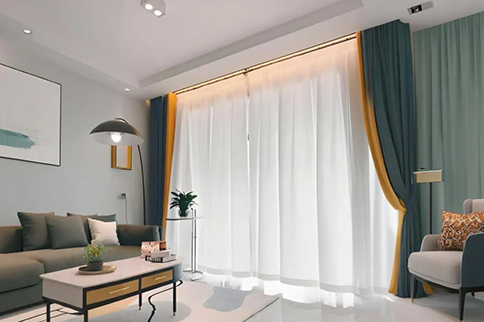
This is not an overreaction. According to 2025 statistics from the National Fire and Rescue Bureau, 44% of residential fires nationwide are caused by electrical issues—such as short-circuited chargers, worn-out outlets, and overloaded circuits. Once a spark lands on curtains, it can ignite an entire wall within seconds, filling the room with thick smoke and blocking escape routes.
Curtains—the fabric closest to the window—are often the critical link that turns a “small spark” into a “major disaster.”
01
Are your curtains fire-resistant?
Here’s a sobering truth: most curtains on the market lack fire-resistant properties. Even those labeled “flame-retardant” typically rely on chemical coatings. These coatings merely delay combustion; they cannot fundamentally stop the burning process. In a real fire, they will still ignite, melt, and may even accelerate the spread of flames.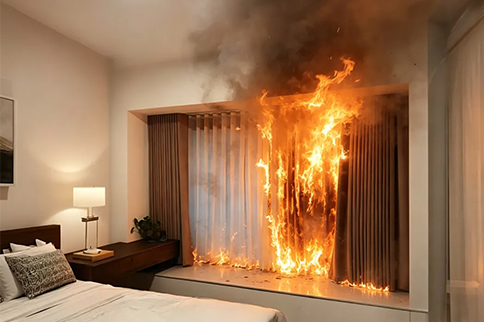
Even more dangerous is the “melt-drip effect.” Many curtain materials melt when heated, turning into high-temperature liquid droplets. These “fireballs,” which can reach temperatures of several hundred degrees, fall onto carpets and mattresses, immediately triggering secondary fires and causing small blazes to spiral out of control.
Furthermore, the thick smoke and toxic gases produced by combustion are the deadliest killers in a fire—80% of casualties result from suffocation and poisoning, not burns.
So, we can’t help but ask: Where exactly is the “safety ceiling” for space protection?
02
Black Fire Carbon-Fiber Non-Flammable Curtains: True Safety Lies in Non-Flammability
Black Fire carbon fiber ultra-high-temperature non-combustible fabric is setting a new “benchmark” for spatial safety.
It is not a flame-retardant material in the traditional sense, but rather a completely new “intrinsically non-combustible” material system.
Unlike flame-retardant solutions that rely on chemical coatings, Black Fire carbon fiber fabric undergoes a fundamental structural modification at the fiber level. This material is “inherently” non-combustible, achieving a “non-flammable” protective effect without any additives or coatings. It can withstand at least three minutes of combustion at an extreme temperature of 1,600°C without showing any significant changes.
Three key advantages set it apart from other fabrics:
1. Intrinsically non-flammable with exceptional heat resistance
Black Fire carbon fiber fabric has a limiting oxygen index (LOI) greater than 45%, far exceeding the 27% standard for flame-retardant materials; most products reach 57%. The fiber structure remains stable at temperatures up to 300°C and can maintain a non-flammable state for over 40 minutes in an oxygen-rich environment at 1,000°C. This means that even if flames spread outside the window, it will not act as a “fuel” but will steadfastly protect the space within.
2. No Melting Droplets, Non-Toxic Smoke
This is the fundamental difference between carbon fiber and traditional flame-retardant materials. It does not soften, shrink, melt, or drip at high temperatures, effectively preventing burns and the risk of secondary ignition, while releasing virtually no toxic fumes. During a fire, this directly impacts the critical window for escape—avoiding burns from molten droplets and suffocation from toxic smoke, thereby securing precious time for evacuation.
3. Soft and Skin-Friendly: Safety and Comfort Combined
“Non-flammable” ≠ stiff. Black Fire carbon fiber fabric overcomes the limitations of traditional high-temperature protective materials—which are often hard and brittle—and, through technical modification, offers both excellent softness and breathability. It hangs naturally and feels comfortable to the touch, just like ordinary curtains, truly balancing “protection” with “comfort.” If necessary, it can be completely removed and used as a fire blanket.
03
Black Fire Carbon Fiber Non-Flammable Curtains: Equipping Spaces with Basic Fire Protection Capabilities
In fact, Black Fire Carbon Fiber Non-Flammable Curtains have transcended the traditional role of decorative materials to become a pre-deployed safety measure.
They are not only suitable for fire source isolation and personal protection in residential spaces but also serve as a fundamental fire safety configuration for government and public buildings, fire risk control and management in high-traffic areas such as educational, medical, and commercial facilities, as well as high-temperature environment isolation and protection in specialized industrial settings. In critical moments, they establish a robust safety barrier for all types of spaces.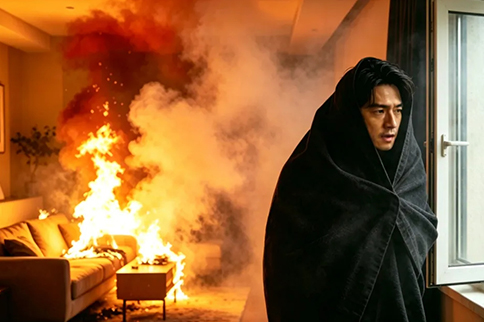
In addition to providing fire barriers, this curtain can also prove invaluable in emergencies.
In the event of a sudden small fire, simply pull it down and drape it over the flames. Thanks to its “non-flammable” properties, it can quickly contain the fire and prevent it from spreading. During an emergency evacuation, draping it over your body can block flames and heat waves, reducing physical harm and providing an extra layer of protection for a safe escape.
04
BlackFire: Defining Intrinsic Safety Through “Non-Flammability”
The application of BlackFire carbon fiber fabric extends far beyond curtains. Currently, this innovative carbon fiber material is widely used in numerous fields critical to public safety, including fire and emergency response, new energy vehicles, national defense and military industries, industrial protection, and logistics and transportation.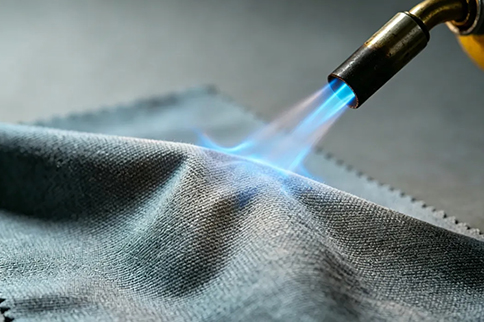
Behind what appears to be an ordinary curtain lies a breakthrough in materials science and an evolution in safety philosophy—from “flame-retardant” to “non-combustible,” and from emergency safety to occupational protection and building safety. Black Fire’s new carbon fiber material is driving “intrinsic safety” into every corner of society across an ever-widening range of fields and scenarios.
When curtains are no longer merely decorative, and when technology truly becomes woven into the fabric of daily life, what we gain is a sense of security that is both more grounded and more reassuring.
LATEST POST
Let’s create something amazing together
contact us
-
 905, Yanxiang Technology Building, Binkang Road, Binjiang District, Hangzhou City, Zhejiang Province, China
 -
 +86-057186797597
 -
 +86-15658877105
 -

- QUICK LINKS
- Home
- About BlackFire
- Our Story
- FAQ
- QUICK LINKS
- Technology
- Application
- Contact Us
- NEWS & INSIGHTS
- Company News
- Industry News
Don't hesitate to contact when you need us!

