


 English
  عربى
عربى  中文简体
中文简体
From “heat-resistant up to 3,000°C” to “wide-ranging applications,” this “miracle fabric” comes from a company in Haishu!
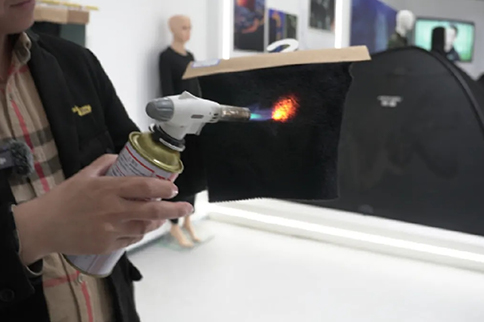
A blue flame shot out of a propane torch heated to 1,300°C, repeatedly licking at the black jacket Xing Bin was wearing. Upon closer inspection, the bright golden flame could be seen flowing through the texture of the black fabric. As soon as the torch was moved away, the flowing flame vanished instantly, leaving the jacket intact—it even retained a faint warmth to the touch.
Throughout this impromptu demonstration conducted by Xing Bin, CEO of Ningbo Black Fire—a company based in Haishu—he remained completely composed. After this “thrilling” impromptu demonstration, he even cracked a joke: “The whole process was just warm. Go ahead and touch the spot that was just burned—it’s not hot at all!”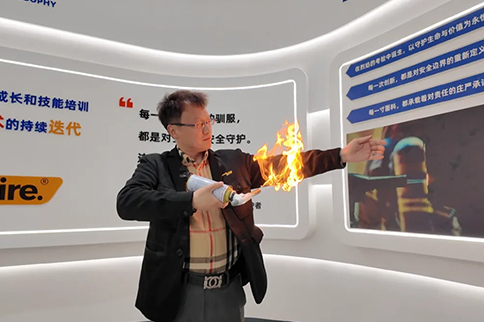
This “magical fabric” is actually a super-high-temperature, flame-retardant material independently developed by the company. Since standing out in the Haishu Innovation and Entrepreneurship Competition three years ago with its products and technology, Black Fire has since explored and even implemented applications in a wider range of scenarios and fields. This innovative product not only fully leverages its strengths in specialized sectors but also delivers high efficiency in civilian and commercial applications, maximizing personal safety.
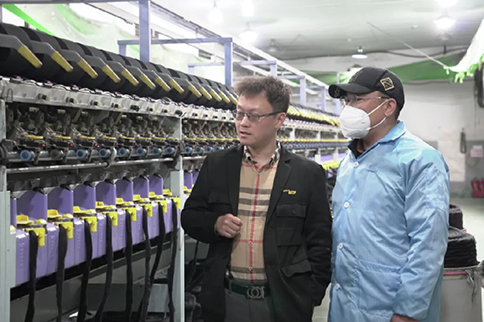
01 Dual Modification: Solving the Challenge of Transforming Rigid Materials into Flexible Ones
In recent years, driven by the explosive growth of the new energy industry, advancements in industrial protection, and heightened safety awareness across the sector, the global market for ultra-high-temperature protective materials—which are highly heat-resistant, non-flammable, smoke-free, lightweight, and offer long-term stability—has experienced rapid growth. The simultaneous expansion of market scale and application scope has collectively propelled ultra-high-temperature non-flammable fabrics from “specialty materials” to “essential products,” providing vast opportunities for technological innovation and commercialization within the industry.
Haishu-based Jingzhen Technology is dedicated to this field. Its technological breakthrough lies in enhancing and empowering traditional flame-retardant fabrics.
Xing Bin explained that traditional fire-resistant and heat-insulating fabrics typically employ “coating-composite” or “post-treatment” methods, relying on external coatings to achieve flame retardancy. These methods suffer from poor heat resistance, susceptibility to peeling, and weak durability, rendering them incapable of withstanding extreme ultra-high-temperature scenarios. Meanwhile, some imported fire-resistant and heat-insulating fabrics not only have limited heat resistance but are also relatively expensive.
With this in mind, Black Fire has established itself on a core technological path of dual “secondary modification,” forging a path of material innovation that is both independent and controllable.
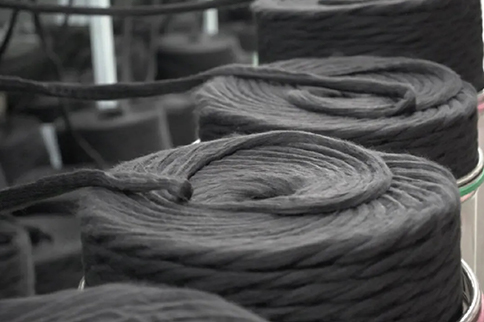
The process ranges from the raw material—acrylonitrile filaments—to ultra-high-temperature, flame-retardant carbon fiber fabric, passing through three key stages: carbon fiber filaments, carbon fiber staple fibers, and carbon fiber yarn. Each of these stages is made possible by two critical rounds of technical modification, thereby solving the core challenge of transforming “rigid fibers into flexible materials.” This represents a technical advantage that sets us apart from our competitors.
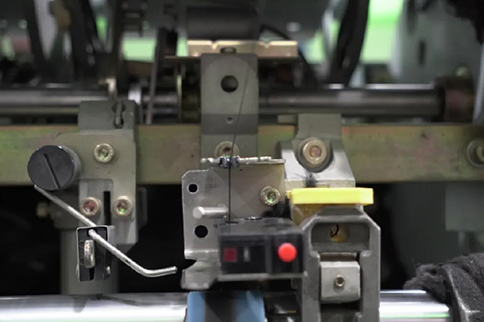
“We use polyacrylonitrile filaments as raw material and, through pre-oxidation and carbonization processes, transform them into a carbon fiber structure with high-temperature resistance and flame-retardant properties. However, despite these properties, the material remains brittle and rigid, making it unsuitable for textile applications. Therefore, we employ technical methods to perform an initial modification, transforming it into carbon staple fibers with strong inter-fiber bonding,” explained Xing Bin. “Next, by subjecting the carbon staple fibers to a second round of technical modification, we transform them into soft, spinnable yarns, which are ultimately woven into fabric,” he added.
02: One Layer Equals Four—Lightweight Yet Secure
What gives this “magical fabric” its ultra-high-temperature flame-retardant properties is another “secret weapon” from Black Fire.
The limiting oxygen index is a key indicator of high-temperature protective capability; it refers to the volume concentration of oxygen in a mixture of oxygen and nitrogen gases at which a polymer can just sustain combustion. A high oxygen index indicates that the material is difficult to ignite, while a low oxygen index indicates that the material is easy to ignite. Online sources indicate that materials with an oxygen index <22% are generally considered flammable, those between 22% and 27% are combustible, and those >27% are flame-retardant.
“Over the past two years, through our proprietary patented technology, we have raised the limiting oxygen index of our yarns and fabrics to 57%,” “This means that at this oxygen index, the fabric is non-flammable,” said Xing Bin. “Even when exposed to a blowtorch reaching 3,000 degrees Celsius, it will not burn and its structure will remain intact.”
Another key indicator is thermal protection performance (TPP), which refers to the amount of thermal energy that can cause second-degree burns to the human body through the fabric.
“Generally, firefighting suits have a four-layer structure, with a combined TPP of 35 calories per square centimeter (cal/cm²), but the overall garment is very heavy,” said Xing Bin. In contrast, the ultra-high-temperature non-flammable fabric independently developed by Black Fire achieves a TPP of 35 calories per square centimeter (cal/cm²) with a single layer, offering fire resistance and thermal insulation while remaining lightweight and breathable.
The case studies and data provided by professional testing facilities are far more persuasive.
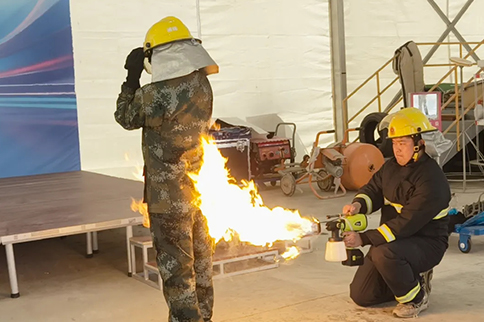
In a specialized laboratory at Tsinghua University’s Hefei Institute of Public Safety, dedicated to conducting flashover tests on dummies, firefighting suits made from fabric independently developed by Black Fire underwent an extreme high-temperature “test”: under temperatures exceeding 1,000 degrees Celsius, aside from minor damage to the lining, the ultra-high-temperature non-flammable fabric remained completely intact, with no changes in its strength, durability, or shape.
The final test report showed that, under the protection of Black Fire’s “miraculous fabric,” the burn rate on the dummy was 0%.
Xing Bin told reporters that, to his knowledge, the burn rate for most firefighting suits currently on the market is around 27%; even the best ultra-high-temperature flame-retardant fabrics from abroad can only achieve a burn rate of 6.1%.
Not only does it offer superior performance, but the price is also “very attractive.” Compared to traditional high-performance flame-retardant fabrics and imported aramid, this “domestically produced” new fabric is about 20% cheaper.
This also means that the “magic fabric” is not only softer and more comfortable, but its applications and scope will also be broader.
03 Comprehensive Coverage for Safety
In fact, Xing Bin, who keenly senses shifts in market demand, had already begun planning and laying the groundwork. Leveraging the robust support of its core technology, Black Fire is working toward the goal of “comprehensive coverage for personal safety,” expanding its reach from “core materials” to “scenario-based solutions” to ensure this new fabric technology is applied across a wider range of scenarios.
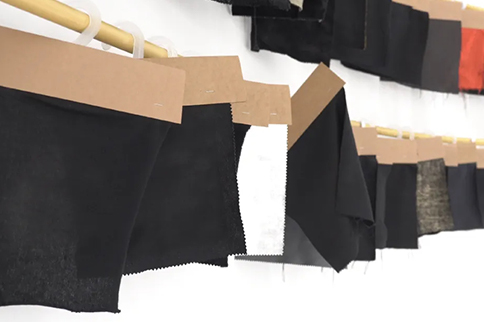
Compared to the low-elasticity black “first-generation” fabric the reporter saw during the initial interview three years ago, this time, in Black Fire’s product showroom, the reporter encountered colors such as black-gold, gold, and dark green—even the black fabric, to borrow a current trend, features a “multi-hued black.”
Upon closer inspection and touch, one can immediately discern that these fabrics differ in texture, feel, and softness: some resemble linen but are softer, others mimic plush fabrics, and there are even leather-like options. Depending on the specific application and requirements, different fabric variants can be selected.
In recent years, thermal runaway in new energy vehicle batteries has drawn significant attention, and there is an urgent need for more effective solutions to protect personal safety and minimize damage.
“We have developed the ‘Underground Parking Garage Charging Thermal Runaway Protection System.’ When a vehicle experiences thermal runaway, a large amount of smoke is generated. Upon detecting the smoke, sensors immediately trigger an alarm and pinpoint the location. A fire-resistant and heat-insulating protective barrier then descends from both sides to swiftly contain the spread of flames,” said Xing Bin. When firefighters arrive at the scene, they simply need to cover the vehicle with the accompanying fire-suppression blanket designed for new energy vehicles until the fire extinguishes naturally, thereby keeping the combustion within manageable limits and preventing further accidents and losses.
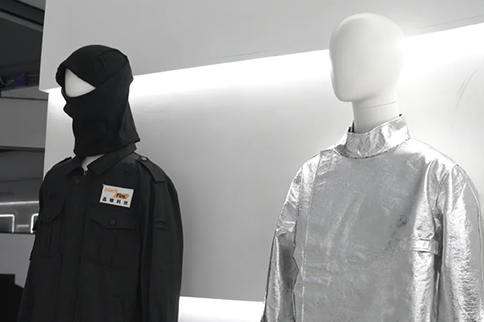
Currently, Black Fire has developed a series of products—including ultra-high-temperature fire-resistant hoods, gloves, neck warmers, arm guards, aprons, tents, and curtains—for ultra-high-temperature environments such as petrochemical plants, steel mills, and firefighting operations, as well as for automotive, household, and outdoor applications. Take aprons and curtains as examples: not only can they be used for cooking and daily decoration, but they also serve as effective barriers in hazardous situations, making them highly practical.
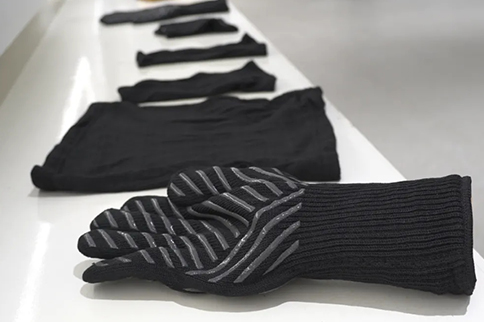
Thanks to its ultra-high-temperature fire-resistant properties and wide range of applications, Black Fire’s “magical fabric” is gradually gaining popularity in the market.
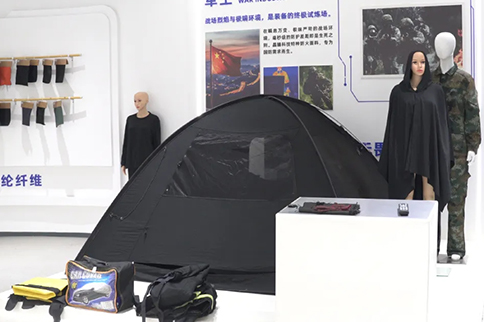
“We’ve been investing in R&D for the past few years, and last year we began pilot and intermediate-scale trials. We’ve now reached mass production capacity. In addition to specialized fields like fire safety, many companies have approached us to discuss partnerships. We expect sales to exceed 60 million yuan by the end of this year,” said Xing Bin.
LATEST POST
Let’s create something amazing together
contact us
-
 905, Yanxiang Technology Building, Binkang Road, Binjiang District, Hangzhou City, Zhejiang Province, China
 -
 +86-057186797597
 -
 +86-15658877105
 -

- QUICK LINKS
- Home
- About BlackFire
- Our Story
- FAQ
- QUICK LINKS
- Technology
- Application
- Contact Us
- NEWS & INSIGHTS
- Company News
- Industry News
Don't hesitate to contact when you need us!

