


 English
  عربى
عربى  中文简体
中文简体
Why do we dare to call ourselves "non-flammable"? What is the essential difference between us and other flame-retardant fabrics on the market?
In the field of fire safety, two terms are easily confused—"flame retardant" and "non-combustible."
Many people believe they are just different ways of saying the same thing. However, this seemingly minor difference can mean the difference between life and death in a real fire.
Today, we will use this article to thoroughly clarify the difference between "flame retardant" and "non-combustible" textile materials.
01
What do the standards say?
According to the national standard GB8624-2012 "Classification of Combustion Performance of Building Materials and Products," the combustion performance of building materials and products is clearly divided into four levels: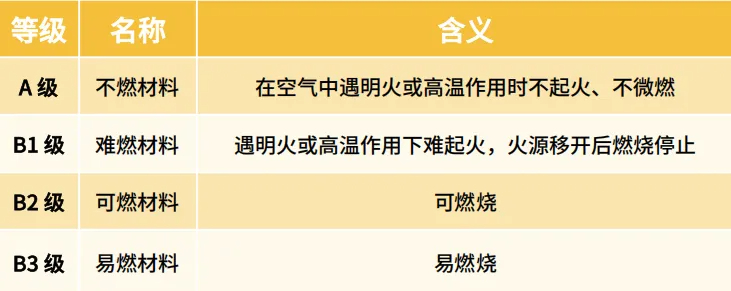
Non-combustible materials (Class A) refer to materials that do not ignite. Flame-retardant materials (Class B1), commonly known as "flame-retardant materials," have good flame-retardant properties, but essentially they "burn slowly," not "don't burn at all."
One "doesn't ignite," the other "burns slower"—this is the fundamental difference.
02
Flame Retardant vs. Non-combustible: Understand with a Table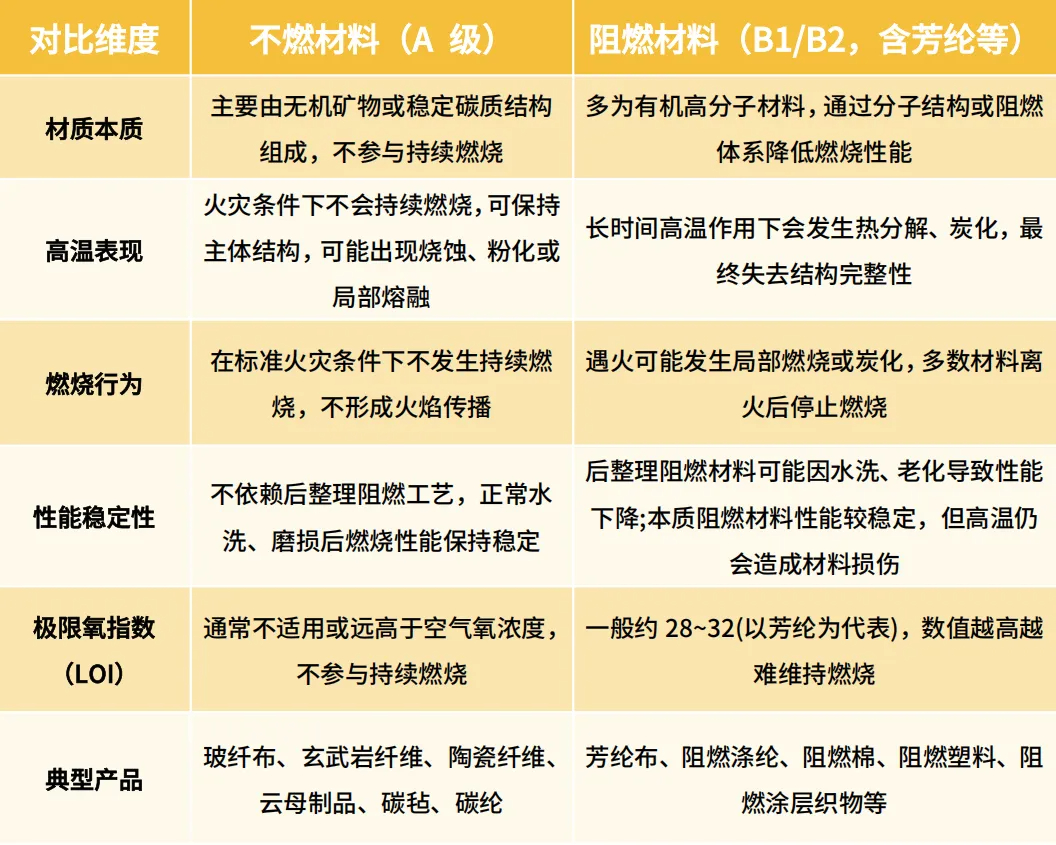
The differences are clear after reviewing the table.
The core logic of flame-retardant materials is "delay," but the material itself still participates in the combustion reaction; non-combustible materials, on the other hand, "block," not supporting combustion from the outset, leaving the fire with no chance.
But the question arises: why this fundamental difference? The answer lies in the molecular structure of the materials.
03
Why this difference?
There are two main ways to achieve "flame retardancy": one is through post-processing, adding flame retardants or coatings to ordinary materials to slow down the burning process—the so-called "addition." However, the material itself is still organic and will eventually decompose and burn at high temperatures, and the flame-retardant effect gradually diminishes with washing and wear.
The other is intrinsic flame retardancy, represented by aramid fibers. The material's molecular structure inherently possesses flame-retardant properties, requiring no external additives, and its performance is stable and long-lasting, but it can still be damaged by extreme temperatures.
"Non-combustible" refers to altering the combustion characteristics at the material's source—the material itself does not undergo sustained combustion and will not become fuel for the spread of fire. Traditionally, non-combustible materials are mostly inorganic materials such as fiberglass and basalt. While these can be industrially produced into fibers, they generally suffer from high processing temperatures, high fiber brittleness, and insufficient flexibility, making it difficult to balance the comfort, durability, and flexibility required for wearable textiles.
Faced with a gap in non-combustible textile fabrics, BlackFire, after long-term research and development, has finally achieved a breakthrough—Black Fire carbon fiber fabric achieves true "intrinsic non-combustibility" at the fiber molecular structure level. It does not rely on any coatings or additives; the material itself "cannot burn." With a limiting oxygen index as high as 57%, 700g of this fabric can maintain structural stability for more than 40 minutes under ultra-high temperature flames exceeding 1600℃, without burning or dripping.
This material has successfully passed the A2 level test conducted by the National Chemical Building Materials Quality Inspection and Testing Center according to GB8624-2012 "Classification of Combustion Performance of Building Materials and Products," making it a pioneer in the application of building-grade non-combustible standards for textile materials, a first in China.
04
What does this difference mean?
In the field of fire-retardant textile materials, the difference between flame-retardant and non-combustible materials goes far beyond the level of technical parameters. It signifies that fire-retardant textile materials are undergoing a paradigm shift from "flame retardant" to "non-combustible."
From the perspective of industrial chain value, the emergence of non-combustible textile materials means that "fire prevention" is no longer just a passive barrier, but an active protection—the material itself is designed for safety. The "non-combustibility" of textile materials is opening up a broader industrial space.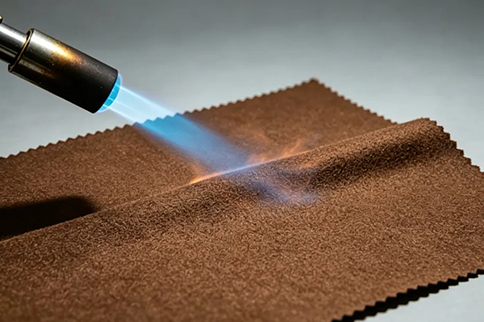
From a national strategic perspective, with "inherent safety" being included in the government work report, the breakthrough in non-flammable textile materials is not only a technological achievement but also a significant step for Chinese materials companies to gain a stronger voice in the global safety and protection industry chain.
Currently, BlackFire has developed non-flammable products based on carbon fiber materials, covering multiple scenarios and widely used in fire emergency response, new energy safety, national defense, industrial protection, logistics and transportation, and home protection. Whether for professional protection or daily life, "non-flammable" is redefining the boundaries of safety.
LATEST POST
Let’s create something amazing together
contact us
-
 905, Yanxiang Technology Building, Binkang Road, Binjiang District, Hangzhou City, Zhejiang Province, China
 -
 +86-057186797597
 -
 +86-15658877105
 -

- QUICK LINKS
- Home
- About BlackFire
- Our Story
- FAQ
- QUICK LINKS
- Technology
- Application
- Contact Us
- NEWS & INSIGHTS
- Company News
- Industry News
Don't hesitate to contact when you need us!

